
Over 80 percent of investors say clear traction metrics are a top factor in deciding where to put their money. Startups often miss out simply because they fail to show precise proof of their growth and momentum. Setting well-defined goals and tracking the right numbers gives your business a clear edge when it comes to attracting serious funding. This guide breaks down the steps for turning raw data into a story investors can trust.
Table of Contents
- Step 1: Define Clear Traction Metrics And Goals
- Step 2: Collect And Organize Relevant Real-World Evidence
- Step 3: Visualize Progress Using Compelling Data Displays
- Step 4: Validate Traction With Real User Or Customer Feedback
- Step 5: Prepare A Credible Traction Story For Investor Meetings
Quick Summary
| Key Point | Explanation |
|---|---|
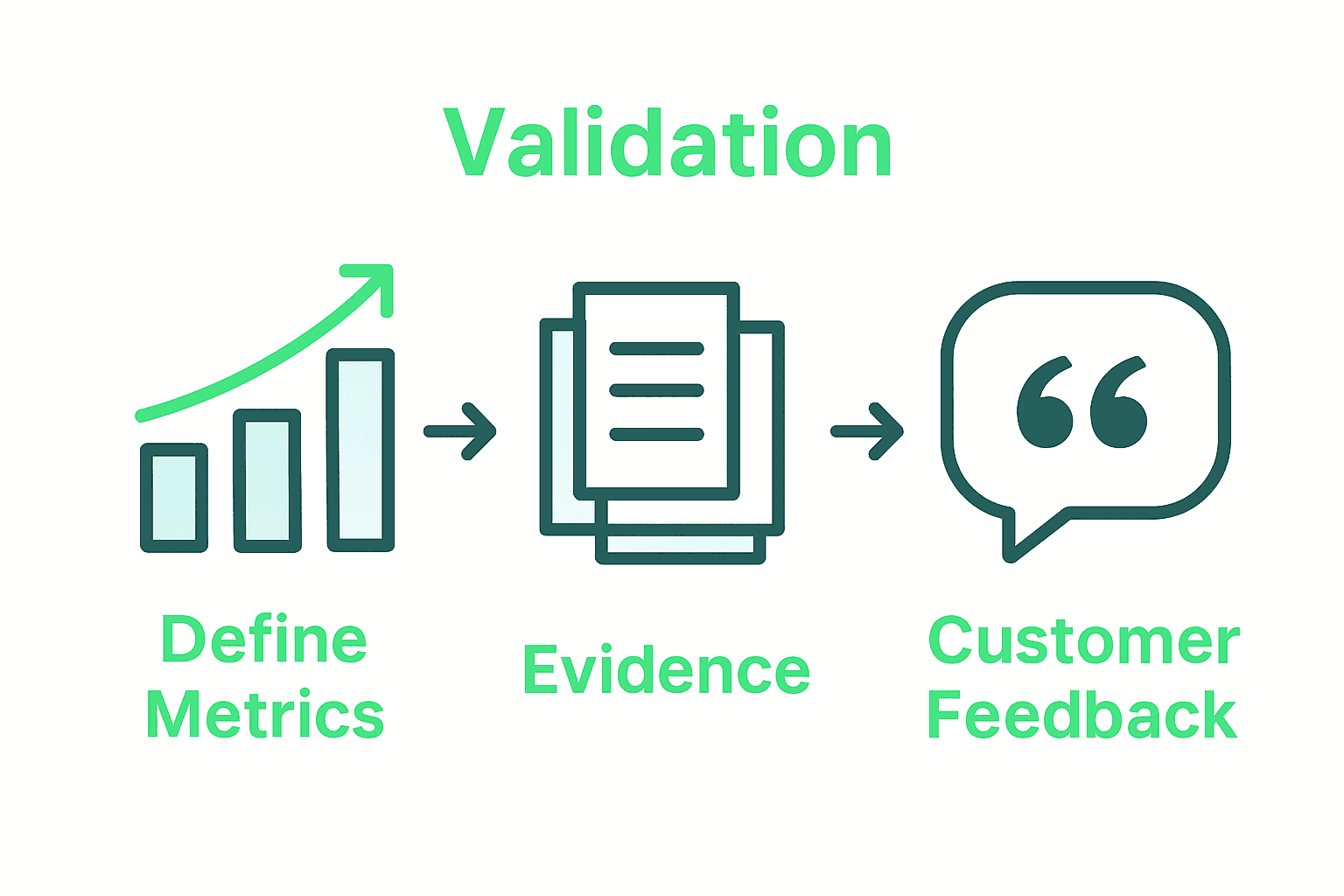
| 1. Define clear traction metrics | Establish quantifiable indicators linked to business growth that attract investors’ interest. |
| 2. Collect real-world evidence | Gather tangible proof, including testimonials and performance data, to validate your startup’s claims. |
| 3. Visualize data effectively | Use clean and professional visual displays to communicate metrics and growth trends that engage investors. |
| 4. Validate with customer feedback | Collect and analyze genuine user experiences to demonstrate your product’s effectiveness and value. |
| 5. Craft a compelling traction story | Create a narrative that combines metrics and user feedback to showcase your startup as a viable investment. |
 |
|
Step 1: Define clear traction metrics and goals
In this crucial step, you will establish precise measurements that demonstrate your startup’s growth potential and attract serious investor attention. According to entrepreneurship.zhaw.ch, traction metrics are quantifiable indicators that help measure the success of an innovative product or service.
To define effective traction metrics, start by identifying key performance indicators (KPIs) specific to your business model. These typically include customer acquisition rate, customer retention percentage, monthly recurring revenue, user engagement metrics, and growth trajectory. Each metric should be concrete, measurable, and directly linked to your startup’s core value proposition. For example, a SaaS company might track monthly active users, while an ecommerce platform could focus on average order value and repeat purchase rates.
When selecting metrics, prioritize those that tell a compelling growth story. Investors want to see not just current performance but potential scalability. Focus on metrics that demonstrate consistent improvement and signal future revenue potential. A good rule of thumb is to choose 3-5 primary metrics that comprehensively represent your business momentum. Track these consistently, maintain clean data records, and be prepared to discuss the story behind the numbers during investor conversations.
Pro tip: Align your metrics with industry benchmarks to provide context. Research standard performance indicators in your specific sector to understand how your startup compares to similar companies and what investors will expect to see.
By defining clear traction metrics, you transform abstract potential into tangible evidence of your startup’s viability and growth trajectory.
Ready to dive into the next step of preparing your investor pitch? Let’s continue building your compelling business narrative.
Step 2: Collect and organize relevant real-world evidence
In this step, you will gather concrete proof points that validate your startup’s potential and transform abstract claims into compelling investor narratives. As arxiv suggests through the Causal Roadmap approach, the key is to pre-specify and transparently evaluate your evidence generation strategy.
Start by collecting tangible data that demonstrates your startup’s market traction and potential. This includes customer testimonials, early adoption metrics, pilot program results, and preliminary revenue figures. Seek out both quantitative and qualitative evidence that illustrates your product or service solving real problems. Interview customers who have used your solution, document their specific challenges and how you addressed them, and collect screenshots, usage statistics, or performance improvements that showcase your value proposition.
Organize your evidence systematically to create a clear narrative. Create a structured portfolio that includes detailed case studies, performance charts, user feedback screenshots, and comparative analysis that shows your competitive advantage. Group your evidence into categories such as market validation, customer satisfaction, revenue growth, and product effectiveness. Ensure each piece of evidence is well documented with dates, specific metrics, and clear context that helps investors understand the significance of your achievements.
Pro tip: Use visual storytelling techniques. Transform raw data into compelling graphs, infographics, and concise summaries that quickly communicate your startup’s potential. Investors appreciate clear, visually engaging presentations that make complex information instantly understandable.
By meticulously collecting and organizing real world evidence, you build a persuasive case that transforms your startup from a concept into an investable opportunity.

Ready to turn your evidence into a powerful investor presentation? Let’s move to the next strategic step.
Step 3: Visualize progress using compelling data displays
In this critical step, you will transform raw numbers into a powerful visual narrative that captures investors attention and demonstrates your startups growth potential. As certificationpoint.org highlights, metrics visualization enables the identification of trends and successes that facilitate informed decision-making.
Create dynamic dashboards that tell a clear story of your startup’s trajectory. Select visualization types that match your key performance indicators chart growth rates using line graphs, display market penetration with pie charts, and illustrate customer acquisition through bar graphs. Each visualization should provide instant insights into your business momentum. Focus on clean, professional designs that emphasize clarity over complexity. Use color coding strategically highlight positive trends green for growth, neutral colors for stable metrics, and carefully chosen accent colors to draw attention to significant achievements.
Design your visual displays with investor perspective in mind. Develop a consistent visual language that makes comparisons easy and demonstrates progression over time. Include comparative benchmarks where possible to show how your startup performs relative to industry standards. Add brief annotations that provide context for significant data points helping investors quickly understand the story behind the numbers. Ensure your visualizations are not just aesthetically pleasing but also intellectually rigorous conveying a narrative of strategic growth and potential.
Pro tip: Practice explaining each visualization as if you were presenting to an investor. The ability to confidently narrate your data story is just as important as the visuals themselves.
By transforming your metrics into compelling visual narratives, you create a powerful tool that speaks directly to investors potential for success.
Ready to refine your investor presentation? Your data is about to become your most persuasive pitch.
Step 4: Validate traction with real user or customer feedback
In this pivotal step, you will gather authentic insights that transform your startup’s narrative from speculation to substantiated potential. Arxiv research underscores the critical importance of customer involvement, highlighting how engaging users validates product development and ensures alignment with market needs.
Develop a systematic approach to collecting meaningful customer feedback. Implement multiple feedback channels including structured surveys, one-on-one interviews, user testing sessions, and digital feedback mechanisms. Focus on gathering both quantitative metrics and qualitative narratives that reveal deeper insights into user experiences. Ask specific questions that uncover not just satisfaction levels but also pain points, unexpected use cases, and potential improvements. Capture video testimonials, written reviews, and detailed case studies that demonstrate tangible value and real world impact of your solution.
Analyze and curate your feedback strategically for investor presentations. Look for patterns that illustrate consistent user value, highlight testimonials from influential or representative customers, and compile evidence that shows your product solving genuine problems. As Arxiv notes for software startups, incorporating customer feedback is crucial for adapting to fast growing markets and resource constraints. Select feedback that demonstrates your ability to iterate quickly and respond to user needs.
Pro tip: Authenticity matters more than perfection. Investors appreciate honest feedback that shows your commitment to continuous improvement and customer satisfaction.
By validating your traction through genuine user experiences, you transform customer voices into your most compelling investment argument.
Ready to turn customer insights into investor confidence? Your journey to persuasive proof is just beginning.
Step 5: Prepare a credible traction story for investor meetings
In this critical stage, you will craft a compelling narrative that transforms your startup data into an irresistible investment opportunity. Learn to weave your metrics metrics, user feedback, and growth potential into a coherent story that speaks directly to investor interests. How to Pitch Ideas in 2025 highlights the importance of creating a narrative that resonates with potential investors.
Structure your traction story with strategic precision. Begin with a powerful opening that defines the problem your startup solves, then progressively build credibility through carefully selected evidence. Use a narrative arc that moves from initial challenge to your unique solution, supported by concrete metrics demonstrating market validation. Organize your presentation to show not just where you are but where you are going. Highlight key milestones achieved, current growth rates, customer acquisition costs, and projected scalability. Create a clear progression that shows investors your startup is not just a good idea but a calculated opportunity with measurable potential.
Prepare for deep investor scrutiny by anticipating and addressing potential questions. Develop a comprehensive yet concise presentation that balances technical details with emotional engagement. Include backup slides with detailed metrics, but keep your primary presentation clean and focused. Practice delivering your story with confidence rehearse your pitch until it feels natural and conversational. Demonstrate your deep understanding of the market while showing adaptability and strategic thinking.
Pro tip: Investors invest in founders as much as ideas. Your passion authenticity and clear strategic vision will be as important as the numbers you present.
By transforming raw data into a compelling narrative you turn your startup from a potential investment into an attractive opportunity.
Ready to make your final pitch preparations? Your investor meeting is about to become a turning point in your entrepreneurial journey.
Unlock Your Startup’s True Potential with siift.ai
Showing traction to investors requires more than just numbers. It calls for clear traction metrics, organized real-world evidence, and a compelling story that highlights your growth and scalability. If you are struggling to define these key indicators or to visualize your progress in a way that truly resonates with investors, you are not alone. Many founders face the challenge of transforming abstract ideas into concrete proof that inspires confidence and secures funding.
siift.ai Intelligent Business Canvas is designed to help founders like you overcome these exact hurdles. This intuitive AI-powered platform guides you step-by-step through ideation, validation, and go-to-market strategies. Get personalized feedback and actionable insights to define traction metrics, collect authentic customer evidence, and prepare a credible, investor-ready narrative. Take control of your founder’s journey without the bias, blind spots, or pressure that often hold startups back.
Ready to turn your traction story into investment-ready proof right now Explore how siift.ai can help you systematically build confidence with real data and strategic clarity. Start your transformation today with the Intelligent Business Canvas and move closer to the funding your startup deserves.
Frequently Asked Questions
How can I define traction metrics for my startup?
To define traction metrics, identify key performance indicators (KPIs) that align with your business model, such as customer acquisition rate or monthly recurring revenue. Start by selecting 3-5 primary metrics that best represent your startup’s growth potential and track them consistently.
What types of real-world evidence should I collect to show traction?
Gather both quantitative data like early revenue figures and qualitative insights such as customer testimonials and case studies. Organize this evidence into categories to create a compelling narrative that showcases your product’s effectiveness and market validation.
How do I create compelling data displays for investor presentations?
Transform metrics into visual formats like graphs and charts that clearly demonstrate your growth trajectory. Use clean designs and color coding to highlight key trends and ensure that your visualizations provide instant insights into your startup’s performance.
What should I include in customer feedback for validating traction?
Collect authentic customer insights through surveys, interviews, and feedback forms that reveal their experiences with your product. Focus on compiling feedback that showcases how your solution addresses real problems, and look for patterns that demonstrate consistent user value.
How do I prepare a compelling traction story for investor meetings?
Craft a narrative that clearly outlines the problem your startup addresses, followed by your unique solution and supporting evidence. Structure your presentation to show progress and future potential, practicing it until you can deliver it confidently and naturally.
What are some common traction metrics to prioritize?
Common traction metrics include customer retention percentage, user engagement metrics, and growth trajectory. Prioritize metrics that tell a compelling story of growth and improvement, which can attract investor interest and demonstrate scalability.
Recommended
- blog | siift | What Is Business Traction? Essential Guide for New Founders 2025
- blog | siift | How to Pitch Ideas in 2025: A Guide for Aspiring Founders
- blog | siift | How to Identify Trends for Your Side Business in 2025
- blog | siift | Business Plan Essentials 2025: A Beginner’s Guide for New Founders
- Unlocking Investor Value Beyond Traditional IR
- The Symbiosis of Innovation and Investment: Navigating the Strategic Continuum of Product Development